AI Job Applications: How AI Agents Apply to Jobs Automatically in 2026
The New Way to Find Roles, Fill ATS Forms, and Apply Without Repeating the Same Work All Day
Updated on:

Written by
Tommy Finzi

Lord of the Applications
Helping job seekers automate their way into a new job.
What “AI Job Applications” Really Means Now
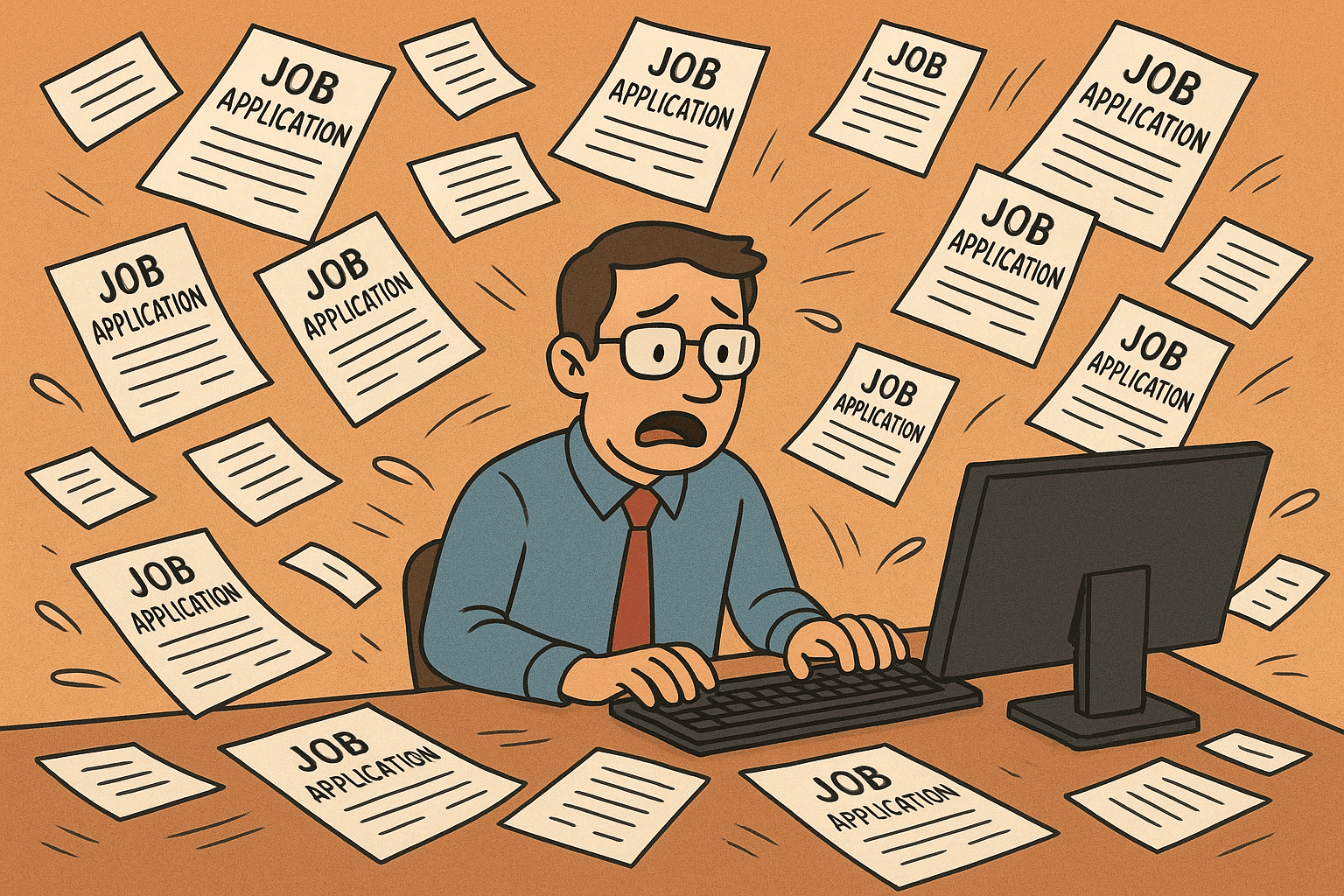
A few years ago, AI job applications mostly meant using a chatbot to improve a resume or write a cover letter. That was useful, but it was still only one piece of the job search. The candidate still had to find the role, open the company website, create another account, paste the same information into another ATS, answer knockout questions, upload documents, and track whether anything actually happened.
In 2026, the meaning has changed. AI job applications now refer to a broader workflow where an AI system can help with the full application journey. It can identify relevant jobs, compare them against a candidate’s resume, extract requirements from the job description, fill application forms, answer role-specific screening questions, and submit applications without the candidate manually repeating the same process every time.
That shift matters because job search has become a strange mix of scarcity and overload. Candidates feel they need to apply to more roles because response rates are unpredictable, but recruiters are also dealing with more applications than they can realistically review. Robert Half reported in 2026 that 67% of U.S. HR leaders said AI-generated applications had slowed hiring, while 84% said HR teams were facing heavier workloads.
That does not mean job seekers should avoid AI. It means low-quality AI is becoming noise. The winning version of AI job applications is not “spray a generic resume everywhere.” It is controlled automation: better targeting, better matching, better form completion, and enough personalization to make each application feel connected to the actual role.
Why AI Agents Are Replacing Manual Job Applications
Manual job applications are not difficult because one form is hard. They are difficult because the same work repeats across dozens or hundreds of roles. A candidate might spend ten minutes on one application, twenty minutes on another, then forty minutes on a company portal that asks them to retype every line of their resume after already uploading it.
That repetition creates fatigue. Once fatigue enters the process, quality drops. Candidates skip roles that would have been a fit because the form is too long. They rush screening questions. They reuse the same cover letter because tailoring every application feels impossible. They lose track of where they applied, then fail to follow up properly.
AI agents solve a different problem from basic AI writing tools. A writing tool helps create content. An agent executes a workflow. That difference is important. A resume generator can improve a document, but it does not remove the operational burden of searching, filling, submitting, and tracking. An AI job application agent is built to handle the repeated steps that make job hunting feel like unpaid admin work.
This is why the keyword “AI job applications” is becoming broader than “AI resume.” The actual user intent is not only “make my resume better.” It is “help me get more relevant applications out without spending my entire day clicking through broken career portals.” AutoApplier already has separate content around how to use AI to apply for jobs automatically, but this page should sit higher in the funnel by explaining the whole category.
The deeper insight is that candidates are not only buying speed. They are buying consistency. A tired person applies in bursts. An agent can apply according to rules. A tired person forgets details. An agent can reuse structured profile data. A tired person avoids annoying ATS forms. An agent can move through them as part of the workflow.
How an AI Job Application Agent Actually Works
A good AI job application agent starts with the candidate’s profile. That means the resume, work history, education, skills, target job titles, preferred locations, salary expectations, remote preferences, seniority level, and dealbreakers. The agent needs this information because automation without context is just a bot.
Once the profile is set, the agent scans for matching roles across job boards, company career pages, and ATS-powered listings. The best agents do not simply look for a keyword in the job title. They compare the role against the candidate’s actual background. A marketing manager role at a SaaS company, for example, might be very different from a marketing manager role in retail, even if the title looks identical.
After finding a role, the agent reads the job description and identifies the key signals. These usually include required skills, preferred tools, location constraints, visa or work authorization requirements, years of experience, industry context, and screening questions. Then it uses the candidate’s profile to complete the application fields accurately.
This is where agent-based automation becomes more valuable than simple autofill. Autofill can paste a name, email, LinkedIn URL, or work history. An AI agent can interpret a question like “Describe your experience managing cross-functional projects” and answer from the candidate’s actual background. It can also avoid inventing experience, which is one of the most important lines between useful automation and dangerous automation.
The best mental model is not “AI applies instead of me.” It is “AI operates from my verified professional profile.” That distinction matters because recruiters are becoming increasingly skeptical of polished but empty applications. A good agent should reduce repetitive work while preserving the candidate’s real experience.
The Difference Between Smart Automation and Application Spam
Most criticism of AI job applications is not really criticism of automation. It is criticism of bad automation. Recruiters hate irrelevant applications because they waste time. Candidates hate irrelevant automation because it produces false activity without interviews. Everyone loses when AI turns the job market into a volume contest with no filter.
Reddit discussions around auto-apply tools show this tension clearly. In job-search communities, some users argue that auto-apply tools are damaging the process by flooding postings with low-fit resumes, while others point out that precise automation can be useful when it matches candidates to roles based on real skills, location, seniority, and preferences. The difference is not whether AI is involved. The difference is whether the AI has rules.
Smart automation starts with constraints. It should know which jobs to ignore. It should avoid roles where the candidate lacks a must-have requirement. It should respect geography, sponsorship requirements, seniority, language, and industry fit. It should not apply to “Head of Sales” because someone has one sales internship. It should not apply to hybrid roles in a city the candidate cannot commute to. It should not answer “yes” to a certification requirement that is not actually true.
Application spam is volume without judgment. Smart AI job applications are volume with targeting. That targeting is what protects the candidate’s reputation and improves the chance that submitted applications are worth reviewing.
This matters for SEO too. A page targeting “AI job applications” should not only say AI is fast. Everyone already knows that. The more persuasive angle is that speed without fit is becoming worthless. The next generation of AI job application tools will compete on relevance, not raw application count.
Why Company Websites and ATS Forms Matter More Than LinkedIn Alone
LinkedIn is important, but it is not the whole job market. Many serious applications still happen on company career pages and ATS platforms. A candidate might discover a role on a job board, but the actual application often takes place inside systems like Workday, Greenhouse, Lever, SmartRecruiters, or another employer portal.
That is why AI job applications should not be framed only as “LinkedIn automation.” LinkedIn Easy Apply is one workflow. Company-site applications are another. ATS forms are often longer, more inconsistent, and more annoying, but they also matter because many employers treat their own careers page as the source of truth.
The Guardian’s reporting on new graduates struggling in a market shaped by AI and tougher employer requirements captures this reality well. Candidates describe applying through job boards, company career pages, and systems that require them to tailor resumes heavily before a person ever sees the application. In that environment, the application problem is not just discovery. It is execution across fragmented systems.
A strong AI job application agent has to handle that fragmentation. It needs to move from role discovery to form completion across different structures. One application might ask for work authorization first. Another might ask for salary expectations. Another might require custom screening answers. Another might parse the resume badly and force the candidate to correct imported fields.
This is where a basic bot breaks. It expects predictable pages. An agent is more useful because it can interpret different forms and respond based on the candidate profile. For a broader internal explanation of this automation layer, the AutoApplier blog post on how to automate job applications is a useful supporting link because it explains why repetitive form work becomes the real bottleneck.
The Real Bottleneck Is Relevance, Not Writing Speed
AI made writing faster. That is no longer rare. Any candidate can generate a cover letter in seconds. Any candidate can ask for a resume rewrite. Any candidate can create a polished paragraph about motivation, teamwork, or leadership.
That creates a new problem. If everyone can sound polished, polish stops being the differentiator. This is exactly the concern raised in Harvard Business Review’s 2026 analysis, which argues that generative AI is weakening traditional hiring signals because candidates can manufacture polished written materials and structured interview answers much more easily than before.
For job seekers, the lesson is not “stop using AI.” The lesson is “use AI where it creates leverage, not where it creates sameness.” A generic AI cover letter does not help much if hundreds of other candidates submit something equally smooth. A tailored application based on real experience is different. It connects the role to proof.
The most valuable AI job applications are built around fit. Fit means the job title makes sense. The seniority matches. The resume has relevant evidence. The screening answers reflect real experience. The application does not exaggerate. The candidate would be able to defend every claim in an interview.
That is why the future belongs to agents that understand the candidate, not tools that only rewrite text. The writing layer matters, but the judgment layer matters more. A good agent should ask, “Is this job worth applying to?” before asking, “How do we apply faster?”
How AI Should Tailor Applications Without Making Them Sound Fake
Recruiters are not against clear writing. They are against applications that sound manufactured. AI-generated applications often fail because they remove the small details that make a candidate believable. They use broad phrases like “proven track record,” “dynamic professional,” and “passionate team player,” but they do not explain what the person actually did.
The solution is not to avoid AI-generated language completely. The solution is to ground every answer in real inputs. If the candidate managed paid social campaigns, the application should mention the channel, budget size, audience, or measurable result where possible. If the candidate worked in customer success, the application should mention retention, onboarding, ticket volume, CRM tools, or customer segments. If the candidate is switching industries, the application should explain transferable skills rather than pretending the match is perfect.
Employ’s 2025 Job Seeker Nation Report shows how normal AI has become in the job search. Among respondents using AI, 69% used it to find or match with relevant listings, 52% used it to write or review resumes, and 48% used it to write or review cover letters. That tells us AI is already part of the process. The question is whether candidates use it to clarify their experience or flatten it into generic language.
A good AI job application system should preserve specificity. It should not invent achievements. It should not stuff keywords invisibly. It should not copy the job description into the resume. The Guardian reported that some candidates tried hidden-text tactics to game screening systems, but ZipRecruiter’s chief economist warned that overly exact matches can be penalized by job site algorithms. That is a useful reminder: trying to trick the system often makes the application weaker.
The best tailoring is honest tailoring. It says, “Here is the part of my background that matches this role,” not “Here is a perfect version of me generated for this job.”
What Recruiters Think About AI Job Applications
Recruiters are in a difficult position. On one side, AI helps them sort, schedule, screen, and move faster. On the other side, AI gives candidates the ability to send more applications, generate more polished materials, and sometimes exaggerate more convincingly.
Greenhouse’s 2025 AI in Hiring Report described this as an AI arms race. Candidates use AI to break through filters. Employers use AI to filter candidates back out. Trust collapses in the middle. The report found that only 8% of job seekers said AI makes hiring more fair, while recruiters and hiring managers were dealing with spam applications, deception concerns, and more pressure to verify what is real.
That context is important because it explains why low-quality AI applications get ignored. When a recruiter opens an application and sees a resume that mirrors the job description too perfectly, a cover letter with no personal detail, and screening answers that sound like a chatbot, the application may feel less trustworthy, not more impressive.
But recruiters do not reject every candidate who uses AI. In reality, many recruiters know AI is now part of the modern job search. The issue is not the tool. The issue is whether the application gives them a reason to believe the candidate is real, relevant, and worth speaking to.
That is why candidates using AI job applications should think beyond submission. The application should create a bridge to the interview. If the agent submits an answer about a project, the candidate should be ready to discuss that project. If the resume emphasizes a skill, the candidate should be able to prove it. AI can help open the door, but the person still has to walk through it.
How to Use AI Job Applications Safely and Strategically
The safest way to use AI job applications is to treat the agent like an operator, not a liar. It should work from your real background, follow your rules, and avoid anything you could not defend in an interview.
That starts with clean profile data. A messy resume creates messy automation. Before using an agent, candidates should make sure their work history, skills, education, locations, portfolio links, and job preferences are accurate. The better the input, the better the agent can judge fit.
The next step is setting boundaries. A candidate should decide what roles are acceptable, what roles are too senior, what industries are irrelevant, what locations are impossible, and what salary ranges are not worth pursuing. These decisions matter because automation scales both good and bad judgment. A bad filter repeated 200 times is worse than no filter at all.
Candidates should also think about privacy. Job applications involve sensitive information: names, addresses, phone numbers, work authorization, employment history, sometimes demographic disclosures, and sometimes compensation expectations. Any AI job application platform should be evaluated not only on speed, but on how seriously it handles personal data.
There is also a strategic layer. AI should free time for the parts of job search that cannot be fully automated: networking, interview prep, portfolio improvement, company research, and follow-ups. Indeed Hiring Lab’s AI at Work Report argues that GenAI is transforming work across a continuum, with many skills becoming hybrid rather than fully automated. Job search follows the same pattern. The best workflow is not fully human or fully AI. It is human judgment plus AI execution.
For candidates who want to go deeper on the narrower LinkedIn-specific version of this topic, AutoApplier’s guide to an AI job application bot supports this article by explaining how job bots handle LinkedIn-style applications. This post should remain broader because the main keyword, “AI job applications,” deserves a wider treatment across platforms, company websites, and agent workflows.
The Future of AI Job Applications
AI job applications are moving from writing assistance to workflow automation. The first wave helped candidates write faster. The second wave helped candidates autofill faster. The next wave is agentic: systems that understand the candidate’s goals, identify relevant roles, complete complex application flows, and keep the search moving while the candidate focuses on higher-value work.
At the same time, the market is becoming less forgiving. Recruiters are already overloaded. Hiring platforms are adding filters. Candidates are skeptical of opaque AI screening. Employers are worried about fake credentials and AI-assisted deception. The result is not a world where every application is automated blindly. It is a world where quality control becomes more important because automation is everywhere.
The candidates who benefit most will not be the ones who submit the most applications. They will be the ones who combine volume with relevance. They will use AI to remove repetitive work, but not to erase their actual story. They will apply faster, but still target carefully. They will let agents handle forms, but they will still prepare to explain their experience clearly when a recruiter calls.
That is the real promise of AI job applications. Not a magic button that guarantees interviews. Not a shortcut that turns every candidate into a perfect match. The real promise is a better operating system for the job search: less repetitive admin, more consistent execution, better targeting, and more time left for the parts of getting hired that still require a human.
In 2026, applying manually to every job is no longer the only serious option. But using AI badly is not a serious option either. The smartest candidates will use AI agents the same way strong professionals use any powerful tool: with clear inputs, clear boundaries, and a clear goal.
Latest posts
Discover other pieces of writing in our blog


Want to apply to 1000+ jobs while watching Netflix?
Join 10,000+ job seekers who automated their way to better opportunities